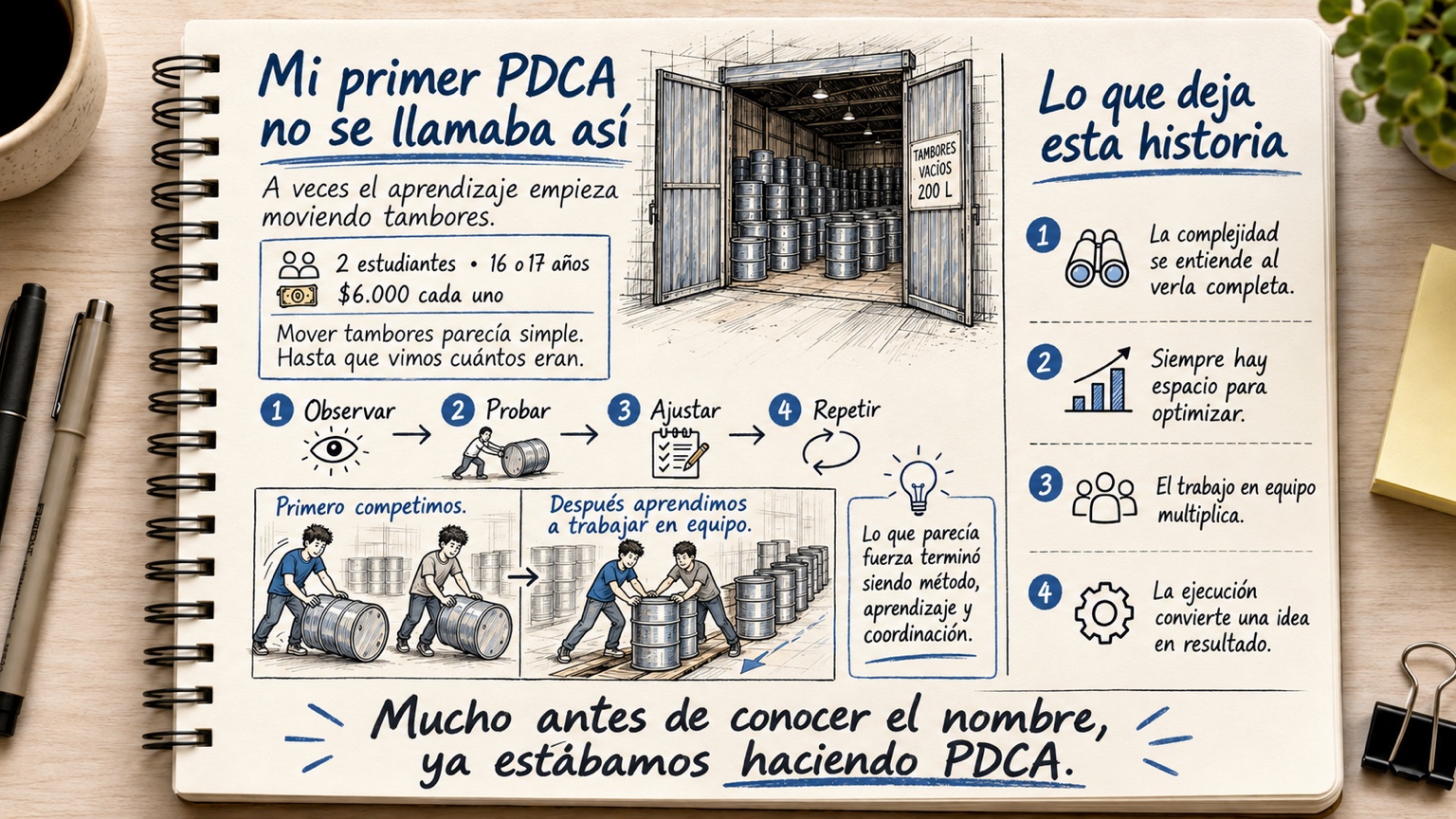
The first PDCA I remember did not happen in a meeting room. We must have been sixteen or seventeen. A friend—let's call him Manuel—offered us 6,000 pesos each to move some empty oil drums. It sounded easy.
On a Saturday we arrived at a service station, walked around the back through an L-shaped corridor no truck could navigate, and reached a large shed. When it opened, the dim space seemed full of an almost infinite number of 200-liter drums. The instruction was short: “Take them over there.” We looked at each other, wondering how we would even get the drums down from the top.
We started one drum at a time and discovered it was better to tip and roll them. First improvement. Then our competitive instincts took over: I could move two, my friend could move three. We realized pushing was not the limit; starting and stopping a whole line of drums was. The job changed. We stopped competing individually and began arranging the groups together. One pushed, the other controlled. We tested, changed the order, corrected and tried again. We finished.
For years I told the story because the mountain of drums had seemed so impressive. Today I think the interesting part is different. Two teenagers from Instituto Nacional—one who would become a respected economics scholar and the other an engineer—were unknowingly doing something very close to PDCA: plan, do, observe, correct and try again. We also discovered that individual optimization had a limit; the system performed better when we worked together.
Nobody had formally taught us continuous improvement. There was just a problem, two teenagers and 6,000 pesos. Over time I learned another lesson: not every decision will work. Pencils have erasers for a reason. Making decisions means accepting mistakes, observing what happened and correcting course. Failing hurts; failing to learn may be the bigger mistake.
After closing my five chapters on strategy and execution, this story came back to me. Long before I knew the names of the tools, I had learned that planning helps, but learning happens in the real world when you act, observe, correct and try again.